




Manufacturing plants rely on network connectivity for everything from production scheduling and inventory management to cloud applications and remote monitoring.
When an internet connection fails, these systems can be disrupted, even if the production equipment itself continues running.
Software-defined wide-area networking (SD-WAN) helps manufacturers manage traffic across their available network connections and automatically redirect traffic when a connection fails or degrades.
But there is a limitation: SD-WAN cannot provide circuit-level failover if every available connection goes down.
For SD-WAN manufacturing deployments, reliable failover depends on the underlying circuits and how much infrastructure they share.
This guide explains how SD-WAN works, its benefits for manufacturing, and why network diversity is essential for maintaining connectivity.
What Is SD-WAN?
SD-WAN is a networking technology that uses software-defined policies to manage traffic across wide-area network (WAN) connections. Rather than relying entirely on manual routing changes, it can monitor connection performance and select suitable paths for different applications.
According to Mplify's SD-WAN service framework, SD-WAN operates as an overlay on top of underlying connectivity services, commonly called the underlay.
The underlay can include services such as Dedicated Internet Access (DIA), business broadband, and MPLS, delivered using technologies such as fiber, fixed wireless, or cellular connections.
SD-WAN can operate over a single connection, but multiple connections are needed for circuit-level failover. The SD-WAN platform manages how traffic uses those connections, while the underlay provides the actual connectivity.
How Does SD-WAN Work?
SD-WAN solutions vary by vendor, but most use a similar approach to managing network traffic.
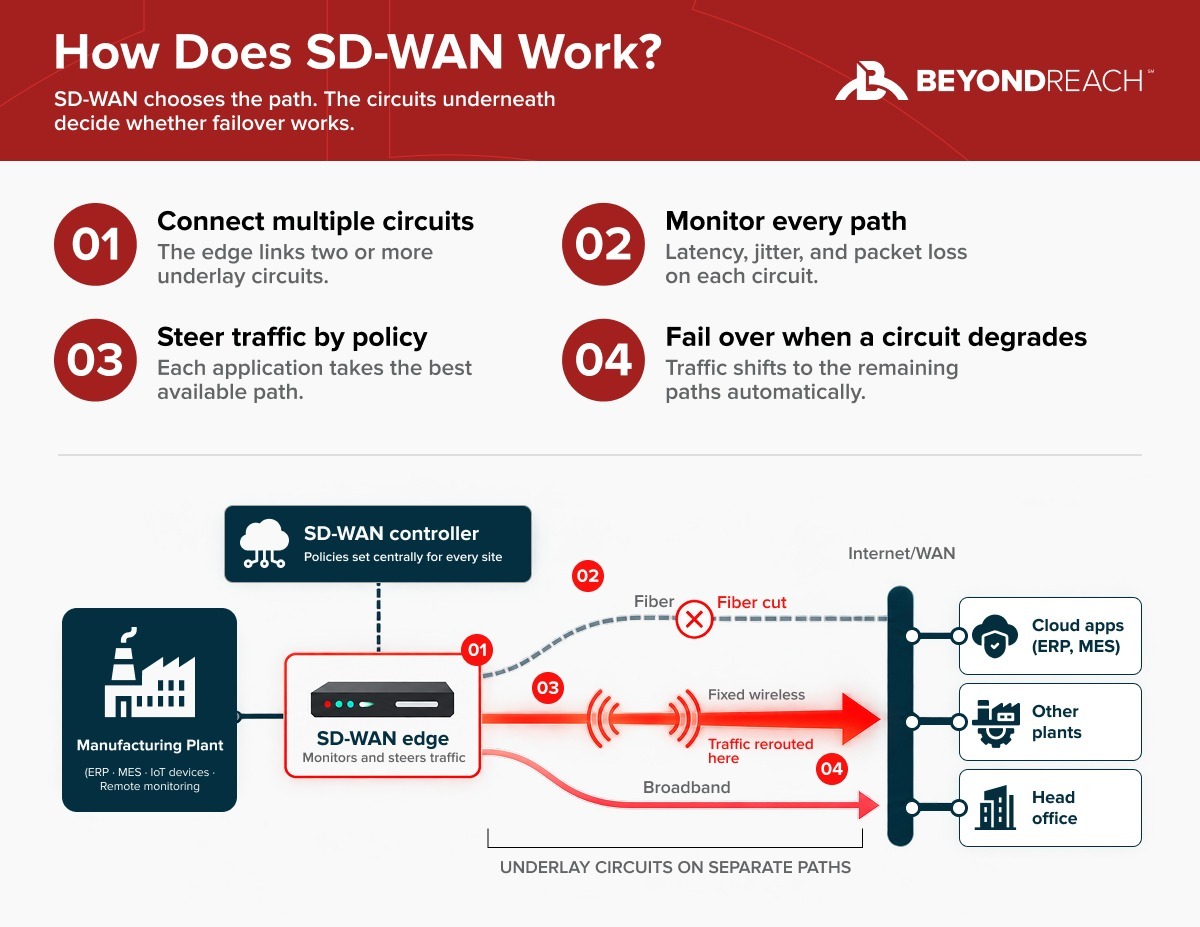
1. Connect available circuits.
An SD-WAN edge device or virtual appliance connects the site to its available WAN services, which may use different providers or delivery methods.
2. Monitor network performance.
The SD-WAN platform measures connection conditions, such as latency, jitter, and packet loss, to identify which available paths are performing well.
3. Direct traffic according to policies.
Application-aware policies determine how traffic uses the available connections. For example, time-sensitive voice communications may be directed over a lower-latency path.
4. Redirect traffic when necessary.
If a connection fails or falls below configured performance thresholds, the platform can move eligible traffic to another available connection.
While SD-WAN failover helps reduce the impact of network disruptions, it does not guarantee uninterrupted application access or identical performance. Its effectiveness depends on the SD-WAN configuration, the applications in use, and the quality of the backup connection.
Why Is SD-WAN Important for Manufacturing?
Manufacturers may operate multiple plants, warehouses, distribution centers, and offices, all requiring access to business applications and shared information.
SD-WAN helps organizations manage these connections more efficiently.
Support Cloud-Based Applications
Manufacturers increasingly use cloud-connected ERP, inventory, production planning, and business management systems.
When internet connectivity fails, employees may lose access to order information, schedules, inventory data, or other resources needed for daily operations.
SD-WAN can help maintain access to these applications by redirecting traffic to an available backup connection.
Improve Multi-Site Network Management
Manufacturing organizations with multiple facilities need consistent network policies and visibility across their locations.
SD-WAN provides centralized management, allowing IT teams to monitor network performance, apply traffic policies, and manage connectivity across multiple sites.
Support Connected Equipment and Remote Monitoring
Industrial IoT devices, equipment monitoring platforms, and remote support systems can depend on connectivity between the plant and external networks.
SD-WAN can help maintain those connections when an individual circuit fails, provided an alternative path is available.
However, machine-level control systems typically operate on local networks. Extremely latency-sensitive industrial control functions generally remain local rather than depending on an external WAN connection.
Improve Network Flexibility and Cost Efficiency
SD-WAN allows organizations to combine different connectivity services, including broadband, DIA, and MPLS.
This flexibility can create opportunities to optimize WAN spending while maintaining appropriate performance for critical applications.
Actual savings depend on the existing network, service requirements, and cost of the additional circuits needed for redundancy.
Support Network Security Strategies
Many SD-WAN platforms support encrypted connections, traffic segmentation, and integration with security services. Some deployments also incorporate secure access service edge (SASE) capabilities.
These functions depend on the selected networking and security platforms. They are separate from the underlying connectivity provided by an internet service provider.
Why Does SD-WAN Failover Depend on Circuit Diversity?
SD-WAN can select an alternative path when a connection fails, but only if another usable connection remains available.
Having independent, reliable connections is therefore essential to designing a resilient manufacturing network.
A Second Circuit Doesn't Guarantee Redundancy
A manufacturing plant may have two internet connections but still be vulnerable to a single outage.
For example, both circuits might:
- Use the same physical conduit or fiber route
- Depend on the same upstream network infrastructure
- Share a carrier or other critical network components
If a shared component fails, both connections may become unavailable simultaneously.
True network redundancy requires evaluating how much infrastructure the connections share.
Using different providers, separate physical routes, and independent upstream infrastructure can reduce common points of failure. However, simply choosing two different carriers does not guarantee complete path diversity.
How Many Connections Does a Manufacturing Plant Need?
There is no universal requirement.
Two connections can provide a primary and backup path. More demanding environments may use a third connection to create another failover option.
The appropriate design depends on:
- Which applications must remain available
- How much disruption the facility can tolerate
- Whether the backup has sufficient bandwidth and performance
- How independently the circuits are routed
- The cost and availability of additional connections
Facilities outside major fiber networks may face additional challenges finding multiple connections that do not share critical infrastructure.
Choosing the Right Circuits for Manufacturing SD-WAN
Not every connection needs the same performance specifications.
The primary connection may support the plant's full daily traffic, while a secondary connection may be designed to maintain only essential applications during an outage.
Two common options are Dedicated Internet Access and business broadband.
DIA vs. Broadband for SD-WAN Failover
|
Feature |
Dedicated Internet Access (DIA) |
Business Broadband |
|
Bandwidth |
Dedicated, symmetrical |
Shared, generally asymmetrical |
|
Performance |
Performance-backed SLAs |
Best-effort service |
|
BeyondReach installation times |
Typically 30 to 90 days |
Typically 15 to 30 days |
|
SD-WAN use case |
Primary or backup connectivity for critical applications |
Cost-effective secondary or tertiary connectivity where best-effort performance is acceptable |
Dedicated Internet Access (DIA) provides dedicated bandwidth with symmetrical upload and download speeds. BeyondReach's standard DIA SLA targets include 99.9% uptime, 30 ms latency, and 99.9% packet delivery.
DIA can be used for primary connectivity or as a backup when critical applications require predictable bandwidth and performance.
Business broadband is a shared, best-effort service that typically does not include a formal performance SLA. It can be a more budget-conscious backup option where reduced performance during an outage is acceptable.
The right choice depends on the facility's applications, traffic requirements, and tolerance for degraded performance.
For a more detailed comparison, see Broadband vs. Dedicated Internet Access (DIA).
How Fixed Wireless Supports SD-WAN Redundancy
Fixed wireless uses radio communication to deliver connectivity between network infrastructure and equipment installed at the customer site.
Unlike a traditional fiber connection, fixed wireless does not require a buried last-mile cable to reach the site. For manufacturing facilities with existing wired connections, a wireless connection can provide an alternative access path, helping improve network redundancy.
Fixed wireless can also connect remote plants, new facilities, and industrial locations where installing fiber would involve significant construction costs or delays.
However, wireless connections may still depend on fiber or other infrastructure further upstream. The level of network diversity depends on the wireless provider's backhaul, network routing, and other shared components.
Fixed wireless is a delivery method, not a separate SD-WAN service. It can support DIA or broadband connectivity within an SD-WAN environment, depending on the site's requirements and available services.
How to Plan Reliable SD-WAN Connectivity for a Manufacturing Site
Manufacturers and their connectivity partners should evaluate more than the number of internet circuits available.
A reliable design starts with understanding what the facility needs during an outage.
Identify critical applications. Determine which systems need to remain connected, such as ERP, inventory management, remote support, and communication platforms.
Evaluate circuit diversity. Review available carriers, physical routes, upstream infrastructure, and shared points of failure.
Define backup performance requirements. Determine whether the backup must support the full workload or only essential applications, and select the appropriate bandwidth and service level.
Confirm network compatibility. Verify that the connections can integrate with the customer's SD-WAN equipment, handoff requirements, and network design.
Test failover performance. Work with the SD-WAN provider or network administrator to validate traffic switching, application behavior, and recovery when the primary connection returns.
These steps help organizations build connectivity strategies that account for the actual conditions at each manufacturing location.
SD-WAN vs. MPLS for Manufacturing
MPLS is a network traffic-forwarding technology commonly used in carrier-managed private WAN services. These services can provide predictable performance for communications between business locations.
SD-WAN, by comparison, is an overlay that manages application traffic across one or more underlying connectivity services.
Manufacturers do not necessarily have to choose one over the other.
An SD-WAN deployment can use an existing MPLS service alongside DIA, broadband, or fixed wireless connections. Combining these connectivity options allows organizations to retain private WAN connectivity where needed while adding flexibility and alternative paths.
Regardless of the combination, reliable failover still depends on having usable connections that do not all fail at the same time.
How BeyondReach Supports SD-WAN Connectivity for Manufacturing
For managed service providers (MSPs), aggregators, ISPs, carriers, and other connectivity partners serving manufacturing customers, sourcing diverse connections can be challenging, especially at remote or hard-to-reach facilities.
BeyondReach helps partners deliver the underlying connectivity that supports their customers' SD-WAN environments.
Our solutions include:
- Diverse backup circuits: DIA and broadband connections designed to reduce shared points of failure with existing services.
- Fixed wireless connectivity: Alternative access paths where traditional fiber connections are limited, delayed, or unable to provide sufficient diversity.
- Extended network reach: Access to an expanding network of wireless ISP partnerships, vertical assets, and other infrastructure to connect challenging locations.
- Temporary connectivity: Interim connections for facilities awaiting permanent service or facing installation delays.
BeyondReach does not replace or manage the customer's SD-WAN platform. The customer's SD-WAN appliance, firewall, router, or other networking equipment controls traffic routing and failover.
Instead, BeyondReach focuses on engineering and delivering the connections those systems depend on.
Whether your manufacturing customer needs a second or third circuit, an alternative to fiber, or connectivity at a challenging location, BeyondReach can help you evaluate available options.
Need diverse connectivity for a manufacturing customer? Request a Quote to discuss your customer's connectivity requirements with BeyondReach.

